
Fundamentally, life encompasses five main developmental processes: growth, cell division and differentiation into different cell types, pattern formation and morphogenesis—the creation of shapes and structures. Cancer is the malignant twist of these processes.
Through the last half of the 20th century, William Harold Fishman, MD, PhD, (1914-2001) was a pioneer in the emerging field of onco-developmental biology, the study of how cancer exploits basic embryonic processes. In other words, how cancer becomes cancer.

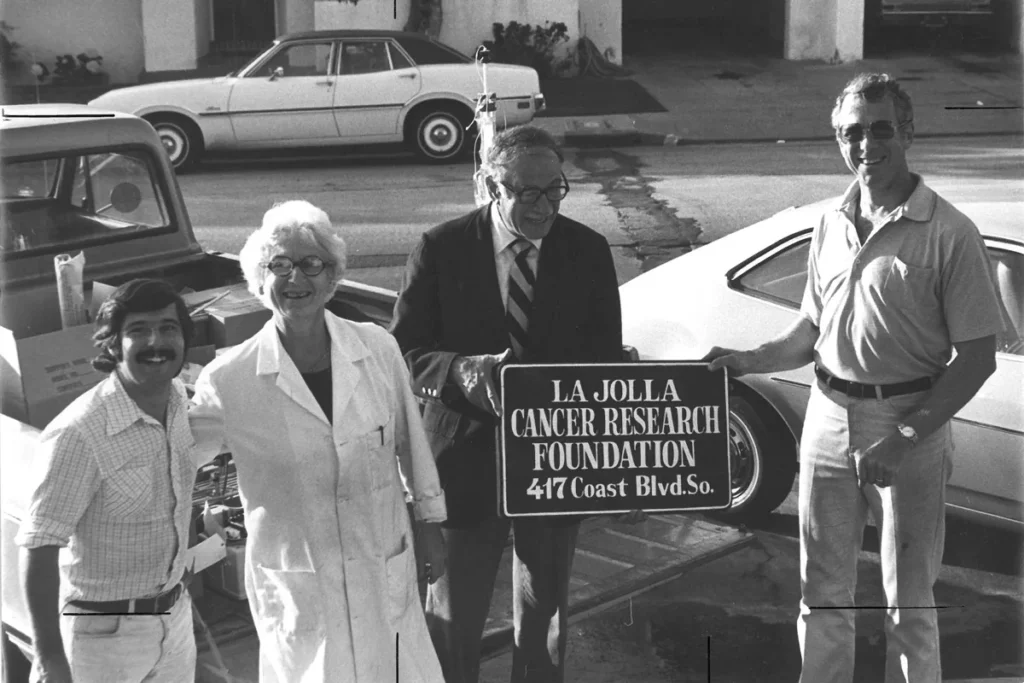
In a long and distinguished research career, which culminated with the founding of the La Jolla Cancer Research Foundation (now Sanford Burnham Prebys Medical Discovery Institute) with his wife Lillian in 1976, Fishman pushed and prodded the new discipline, specifically by identifying markers for diagnosing and monitoring cancers.
At the University of Chicago, for example, Fishman and colleagues defined the relationship between high blood levels of the enzyme beta-glucoronidase and malignant tumor growth.
“This discovery changed biochemistry fundamentally because it was among the earliest reports of an enzyme as a tumor marker,” said William J. McGill, PhD, president emeritus of Columbia University and the third chancellor of UC San Diego. “Biochemistry was seen increasingly as a crucial tool for cancer study.”

As a professor of pathology at Tufts University (1948 to1975), Fishman would develop an enzyme assay (dubbed the Fishman-Lerner method) to detect prostatic acid phosphatase as a tumor marker for prostate cancer, the second most common cancer in men after skin cancer. The goal was to better monitor tumor progression and eliminate unnecessary surgery.
(The Fishman-Lerner method would eventually be replaced by more sensitive diagnostic techniques, including development of the Prostate-Specific Antigen test (see Eva Engvall and the Invention of ELISA, Plus).
After retiring from Tufts in 1975 and with a $180,000 grant in hand from the National Cancer Institute, the Fishmans moved west to establish the La Jolla Cancer Research Foundation, with an emphasis on onco-developmental biology, which has grown and diversified to study specific oncogenes (genes that when mutated or overexpressed can lead to cancer), cancer stem cells and new concepts about how cancers evolve.
This ongoing work, with colleagues at Sanford Burnham Prebys and elsewhere, would include groundbreaking research on extracellular matrix components (see Erkki Ruoslahti and the Discovery of Fibronectin and Integrins), which revealed why normal cells are locked in place but cancer cells can spread (metastasis) and why cancer cells defy apoptosis or programmed cell death (see John Reed and the Deathly Revelations of Apoptosis).
“When we started the La Jolla Cancer Research Foundation in our retirement years, we lived it. We ate it. We slept it. It was a part of us,” recalled Lillian, who passed away in 2013 at the age of 98. “We were determined to find solutions that would help cure human diseases.”